Panorama-Dramatique
Illusions perduesPanorama-Dramatique is a theater on the boulevard du Temple, opposite rue Charlot, whose short-lived history binds the spectacle onstage to the commercial and journalistic machinery behind it. It is at once a struggling provincial-scale rival in a crowded Paris theater district and a proving ground for Lucien: one newspaper article helps make a production succeed, advances two actresses, and shows him how quickly cultural influence can become personal power. The theater’s rise and collapse make that success visible as both real opportunity and precarious construction.
Setting and precarious position
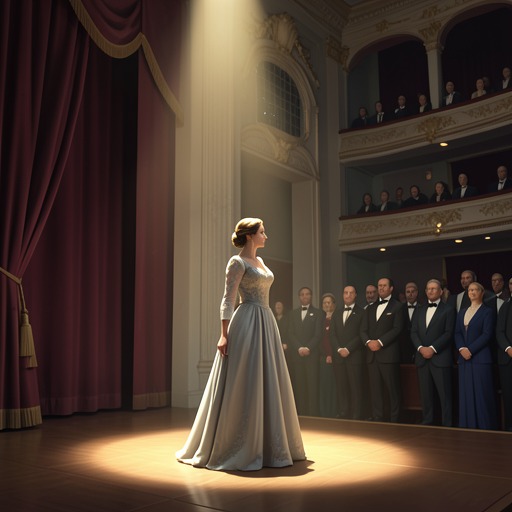
Panorama-Dramatique occupied a charming auditorium, but charm could not overcome its disadvantages. It competed with the Ambigu-Comique, the Gaîté, the Porte-Saint-Martin, and the vaudeville theaters. Its privilege was restricted, established theaters had little incentive to lend it good plays, and authors were reluctant to risk quarrels with successful competitors for a theater whose future already seemed uncertain. Two administrations had failed there without achieving a single success, despite the appearances of Bouffé and Florine. The theater is described as subject to the same fatal pressures as the people who depend on it: its prospects were shaped by a narrow market, limited access to new work, and the power of its rivals.
The management’s hopes rested on a new piece by Du Bruel, a comic melodrama he claimed to have written alone, designed for Florine’s debut. Florine had previously played small roles at the Gaîté without securing an engagement; Panorama-Dramatique drew her away from that neighbor. Coralie was also scheduled to make her debut. The production thus carried several stakes at once: the theater needed a success, Florine needed a stage on which to establish herself, and Coralie’s prospects were tied to the outcome as well.
Backstage and the power of the press
Étienne Lousteau brings Lucien to the theater on the evening of the premiere, after proposing to introduce him to Dauriat and several journalists. The visit begins as a lesson in access. At the entrance, Lousteau’s presence earns deference from the controller, although seating is so scarce that only the director’s box remains available. Lousteau then leads Lucien through a small door into the dark passage between auditorium and stage, up damp steps and into the wings.
From close range, theatrical enchantment gives way to its working materials: narrow stage structures, ladders bearing oil lamps, crude scenery, ropes, painted actors, laborers in greasy jackets, stagehands, firemen, and suspended backdrops. The contrast with the finished spectacle unsettles Lucien. A performance is not simply an illusion presented to an audience; it is an unstable assembly of people, machinery, scenery, and labor. The theater’s backstage also introduces him to the social world that makes the spectacle function, a world in which press influence, personal connections, and commercial interests overlap.
That overlap becomes explicit in the auditorium. The first-night audience includes journalists and their mistresses, theater regulars, fashionable spectators, and businessmen. The director tells Finot that the production’s result depends on Florine and Coralie, whose dancing may win over the crowd, while newspaper articles could help turn a success into a major financial gain. The production is therefore exposed as a wager on both performers and publicity. The stage supplies the event; the newspapers help determine what the event will mean beyond the theater.
The premiere and Lucien’s entry into journalism
During the performance, Du Bruel asks Lucien to write an article about the piece and to smile at the young actress. Lucien agrees, and Coralie plays brilliantly. Bouffé appears amid the applause and credits the play to Raoul and Du Bruel, revealing Raoul Nathan’s involvement despite Du Bruel’s earlier claim to sole authorship. The audience calls for Coralie; from the businessmen’s box, Matifat calls for Florine too. When the curtain rises again, Bouffé returns with the two actresses, and Matifat and Camusot each throw a crown. Coralie picks hers up and gives it to Lucien.
That gesture joins theatrical acclaim to Lucien’s personal transformation. The premiere is his first close encounter with the intoxicating effect of a successful performance and its surrounding machinery. He has come as a provincial poet accompanying Lousteau; he leaves the evening newly conscious that a journalist’s words can affect an actress’s career and a theater’s fortunes. Later, Coralie credits his article with saving the play: without it, she says, the production would have fallen and she would have remained on the boulevard for years. She embraces him in front of Camusot, who recognizes the fine boots Lucien wears. The scene links professional success, romantic attachment, and the outward signs of rising status.
The immediate consequences are concrete. Coralie obtains an engagement at the Gymnase Theatre for twelve thousand francs a year, while Florine is engaged at Panorama-Dramatique for eight thousand. Lousteau takes Lucien from theater to theater, where directors congratulate him and actresses recognize the importance of his article. These small ovations enlarge Lucien in his own estimation: the newspaper has given him an influence that theatrical people respond to in person. At eleven, he and Lousteau return to Panorama-Dramatique, where Nathan greets Lucien and jokes about being buried by the new critic.
A temporary triumph and a commercial collapse
Panorama-Dramatique remains part of Lucien’s new social life even as his sense of belonging changes. Two days before a supper he and Coralie give for friends, the pair walk from rue de Vendôme toward the theater and hear people praising Coralie’s beauty and Lucien’s apparent fitness to be her companion. Lucien feels at home in this world. The literary circle whose ideals had recently mattered to him recedes; he begins to regard its austerity as naïve. His theatrical success is therefore also a turning point in his attachments and ambitions, drawing him toward the immediate rewards of publicity, pleasure, and recognition.
The theater’s commercial fragility soon catches up with it. Finot and Lousteau use press attacks on Florine to manipulate Matifat, her wealthy supporter, into considering the sale of his one-sixth share in Finot’s review. Matifat is led to believe that the attacks arise from Lucien’s interest in Coralie and that the investment may be worth recovering before further calls for funds. But before the theater director declares bankruptcy, he needs to negotiate accommodation bills and warns Matifat about Finot’s scheme. Matifat keeps his share and leaves Florine. The maneuver fails because Matifat’s interests lie in a trade the press cannot readily damage: unlike theater or fashion, his goods cannot be devalued by hostile reviews. With the Panorama-Dramatique facing closure, Florine is left without a secure prospect.
The bankruptcy also changes Coralie’s circumstances. After Lucien’s fortunes have deteriorated, the theater’s failure leaves the couple without their former household staff and with furniture that has been seized. Their remaining valuables have become pawnshop receipts, gathered into a small octavo volume. During the liquidation, Coralie pays what is owed, and the furniture is sold with the creditors’ consent to Cardot, who places Florentine in the apartment. Coralie preserves her love and twelve hundred francs, while Bérénice arranges a modest three-room apartment on the fourth floor of a house on rue de la Lune, near the Gymnase Theatre. The contrast with the earlier theatrical abundance is stark: the venue that once helped usher Lucien and Coralie toward public success ends in a financial failure that strips away the household built around that success.
Narrative significance
Panorama-Dramatique is more than a backdrop for a premiere. Its crowded wings reveal the material labor beneath theatrical glamour, while its dependence on reviews shows how performance and publicity reinforce one another. Lucien’s article produces consequences that can be counted in engagements and salaries, teaching him that press power is not merely an abstract reputation but a practical force in the theater’s economy. At the same time, Matifat’s withdrawal and the theater’s bankruptcy expose the limits of that power: publicity can help manufacture a triumph, but it cannot guarantee a durable business or protect people from financial reversals. The theater’s brief success and eventual closure thus frame Lucien’s entry into a world where applause, influence, and solvency are closely connected, yet never secure.